Listen to the article
Syft in Xero: which tier your property entities actually need
Somewhere in your group there's a spreadsheet doing a job your software already does. It sits beside the one entity where somebody genuinely needs to model next quarter's cash, and it gets rebuilt by hand every quarter because the forecasting in that entity only reaches thirty days ahead. Two doors down, a dormant company holding a single asset carries a richer plan that nobody has opened in a year.
Neither of those is a software failure. It's what a subscription estate looks like when nobody has ever mapped it. Which version of Syft in Xero an entity can reach is decided entirely by the plan that entity happens to be on, and most property groups can't say what that is without opening sixty organisations one at a time.
Ultimate doesn't buy you a better forecast
Xero now runs Syft-powered reporting inside the platform, and what you actually see is gated by plan.
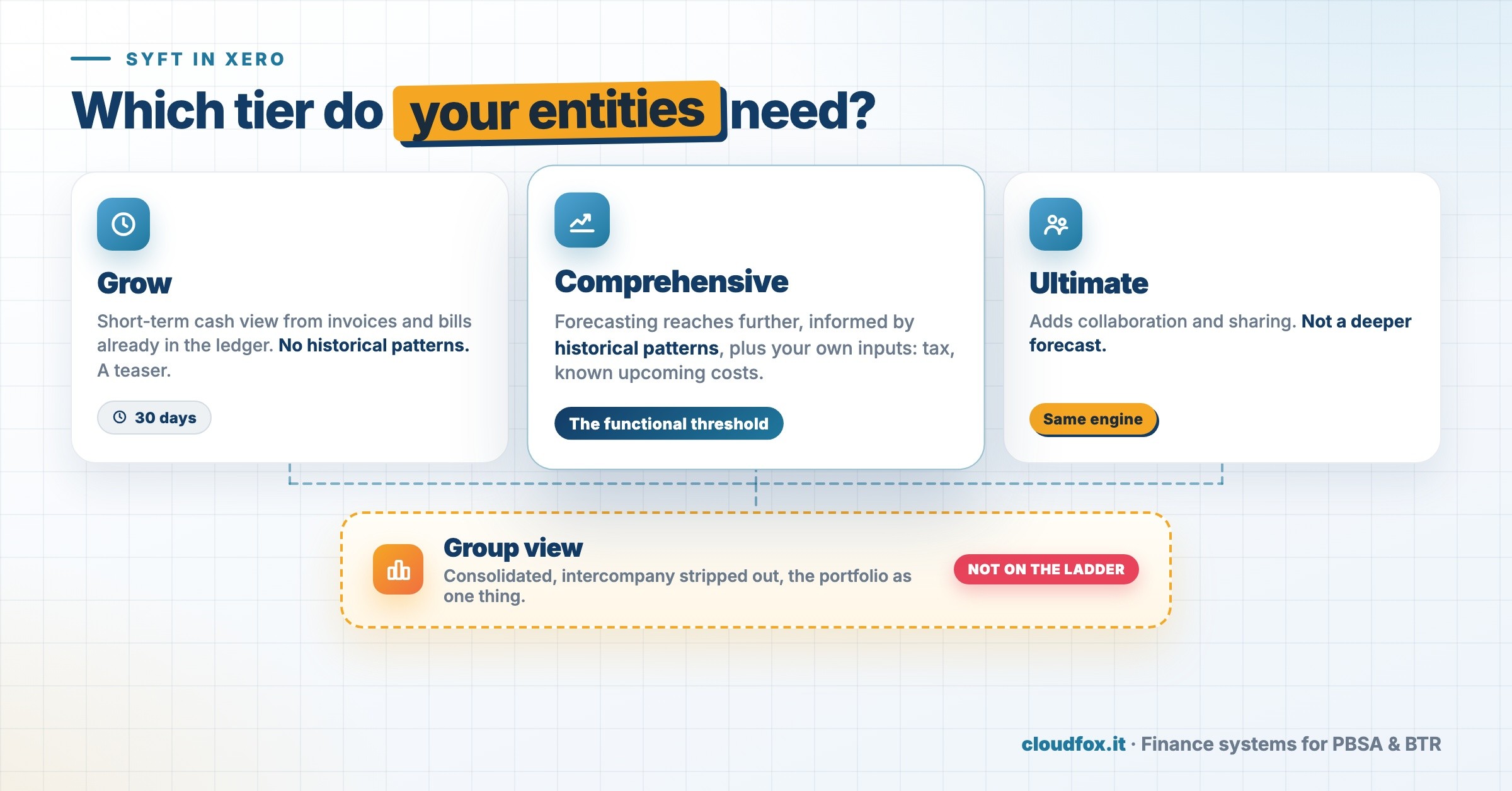
Grow gives you a short-term cash view, roughly thirty days out, built only from the invoices and bills already sitting in the ledger. It isn't drawing on historical patterns and it isn't designed as a planning tool. Treat it as a teaser.
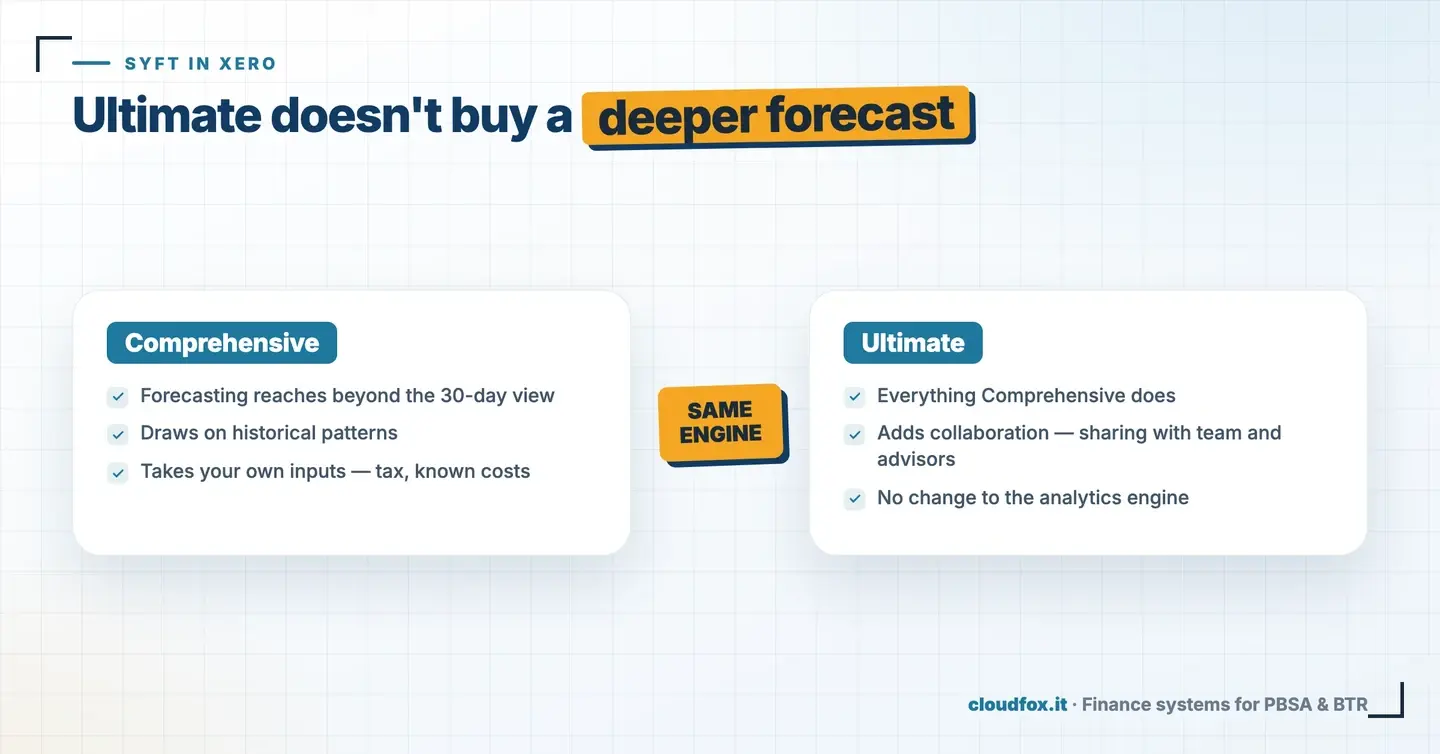
Comprehensive is where it becomes something you'd genuinely use. Forecasting extends further ahead, the system uses historical patterns to inform its predictions, and you can add your own inputs: tax payments, known upcoming costs, the things you can see coming that the ledger can't.
Ultimate is where the assumption breaks. The underlying analytics engine is the same as Comprehensive's. What Ultimate adds is collaboration, better ways to share the numbers and work through them with your team and your advisors. That's a reasonable thing to want. It just isn't a deeper forecast, and groups move to the top tier expecting one.
So if the plan is to put everything on Ultimate and finally get proper forecasting, you'll get the same forecast, shared more neatly.
No Xero plan gives you the group view
Here's the part the tier ladder can't answer at any level.
Syft inside Xero is scoped to the organisation you're logged into. It reports on that entity, from that entity's ledger. That's correct behaviour for a single business and it's the wrong shape for a group, because the number a Group Finance Director actually needs doesn't live in any one entity. It lives across all of them: the consolidated position, intercompany stripped out, the portfolio seen as one thing.
No tier gives you that. Ultimate on every entity in the group still doesn't give you that, because it isn't a capability the ladder sells.
That's the job standalone Syft Analytics does, and it's why "we're on the top Xero plan now, we can drop standalone Syft" is a decision worth catching before someone acts on it. Syft began life as a standalone product and still exists as one. What's built into Xero is a subset of it. The in-Xero version is per-entity reporting; the standalone product is what consolidates the estate. They aren't competing for the same slot in the stack, and cancelling one because you upgraded the other leaves the group blind at exactly the level where it makes decisions.
Why nobody knows which plan each entity is on
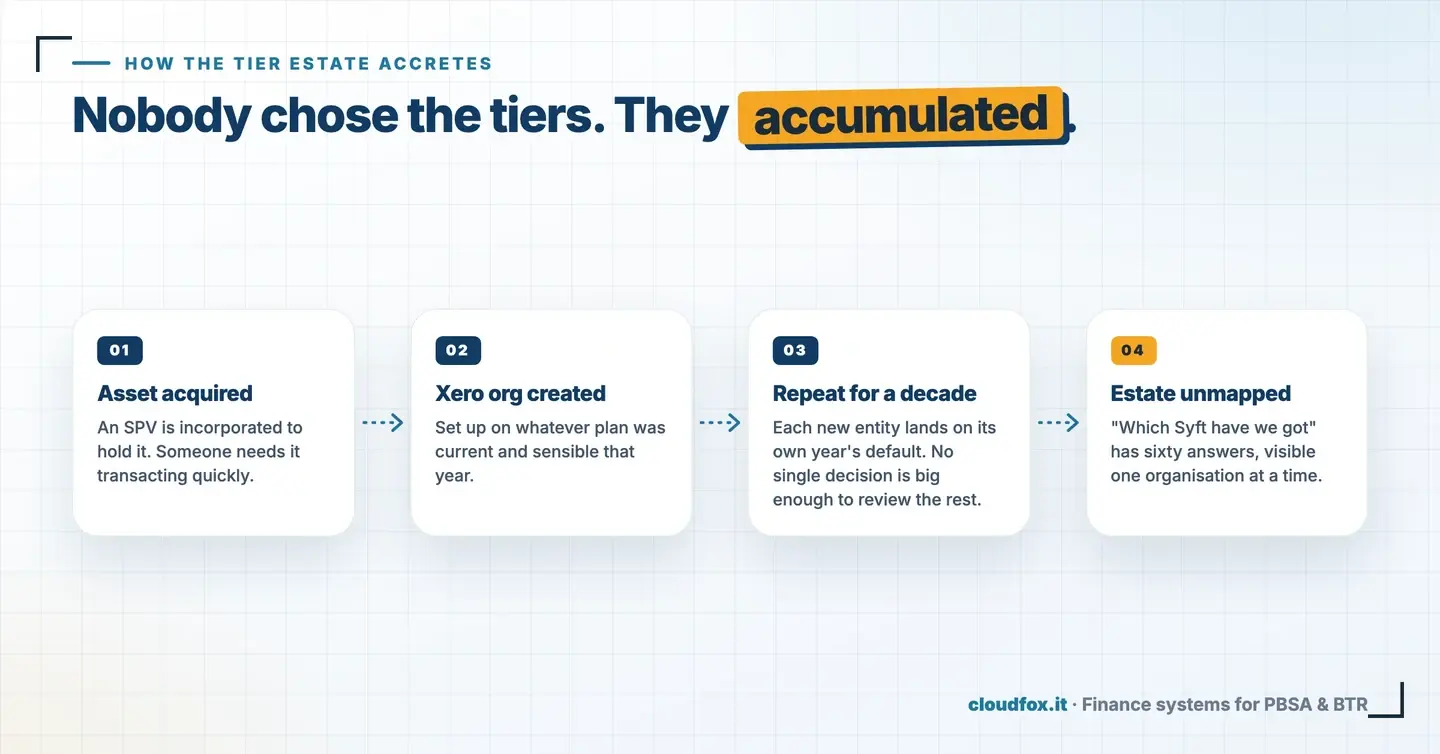
I've never met a property group that chose its subscription tiers. They accumulated them.
An SPV gets incorporated for an asset. Someone sets up a Xero organisation for it on whatever plan was current that year. The next one goes on the next year's default. Repeat that across a decade of acquisitions and a structure of propcos, an opco and a manco, and the tier estate is unmapped, because no single subscription decision was ever big enough to warrant mapping the rest.
So "which Syft have we got" has no answer at group level. It has sixty answers, and they're only visible one organisation at a time.

Tier the estate by what each entity is for
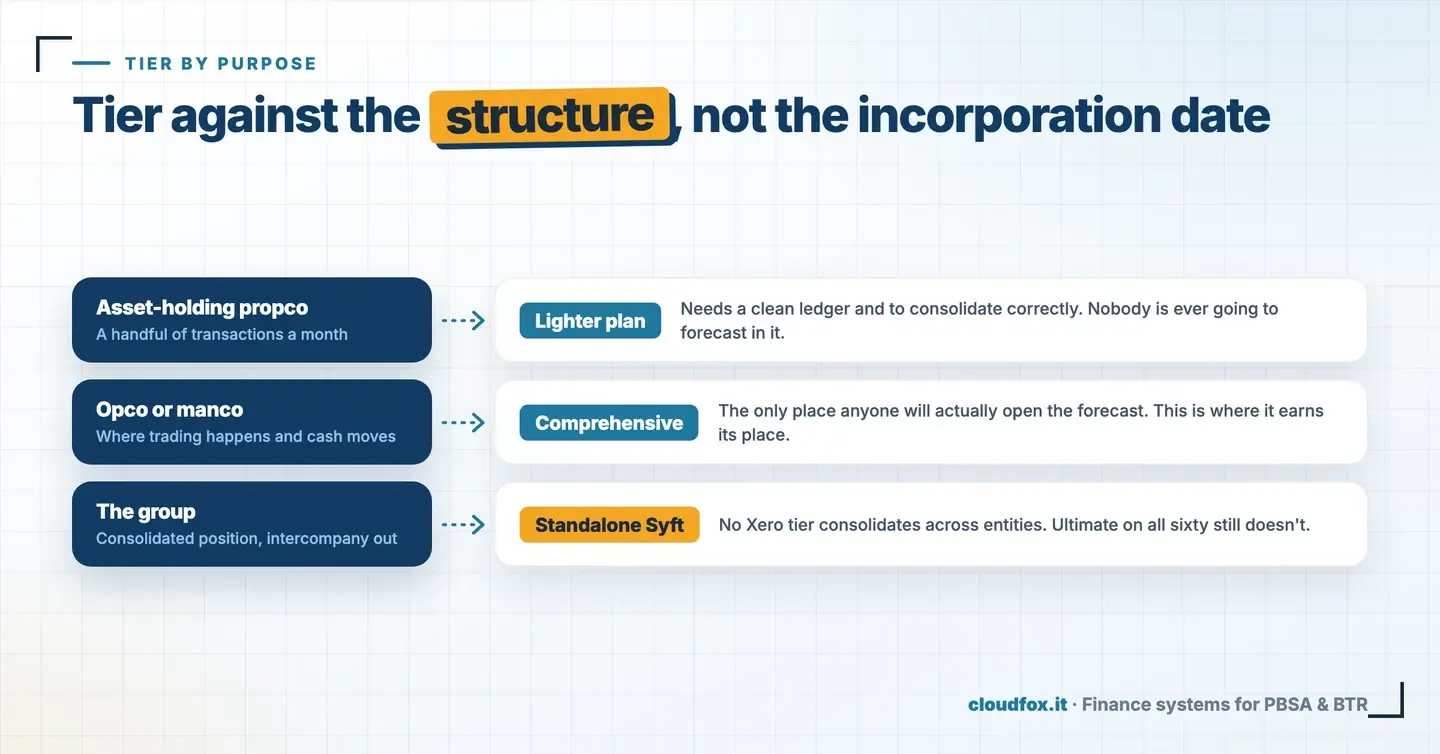
The fix isn't a tier decision. It's a mapping exercise, and it starts by sorting the estate by purpose rather than treating every organisation as an equal unit.
An asset-holding propco with a handful of transactions a month needs a clean ledger and to be consolidated correctly. It doesn't need forecasting, because nobody is ever going to forecast in it. An opco or manco, where the trading happens and the cash actually moves, is where Comprehensive earns its place, because that's the only place anyone will open the forecast. And the group view stays where it belongs, in the layer built to consolidate across entities rather than inside any one of them.
Do that and the tiering falls out of the structure instead of the incorporation date. You stop paying for planning tools in entities that will never plan, and you stop starving the two or three entities that carry the group's actual decisions.
It's the same principle behind every stack we build for PBSA and BTR operators: tier against the structure, not against the incorporation date.
Worth being honest about the rest of it. Even a well-configured group leaves capability on the table. That's normal. The tools move, the estate grows, and the mapping needs revisiting. The groups that get value out of this aren't the ones that bought the most, they're the ones that know what they've got.
What it looks like once someone has actually done it
This is the work we do for property groups, so it's worth describing plainly rather than leaving it as a principle.
We map the estate first: every Xero organisation in the group, what each one is for, and what plan it's sitting on today. Then we configure Syft across those entities against the structure rather than the incorporation history. Comprehensive where somebody will genuinely open a forecast. The lighter plan where an entity only needs a clean ledger and to consolidate correctly. Group-level analytics above all of it, doing the job no tier does.
Then the administration comes off your desk. Your Xero and Syft subscriptions arrive from us as consolidated bills, broken down by entity and by subscription type. One bill for Xero, one for Syft, and a line against each entity naming the plan it's on.
That last part is the bit people underestimate, and it's the whole reason the original question was so hard to answer. Nobody can say which Syft they've got because the answer is scattered across sixty separate subscriptions that are never seen in one place. Put them on a single bill with the tier named against each entity, and the question answers itself every month without anyone running an audit. The mapping stops being a project you keep meaning to do and becomes something you just read.
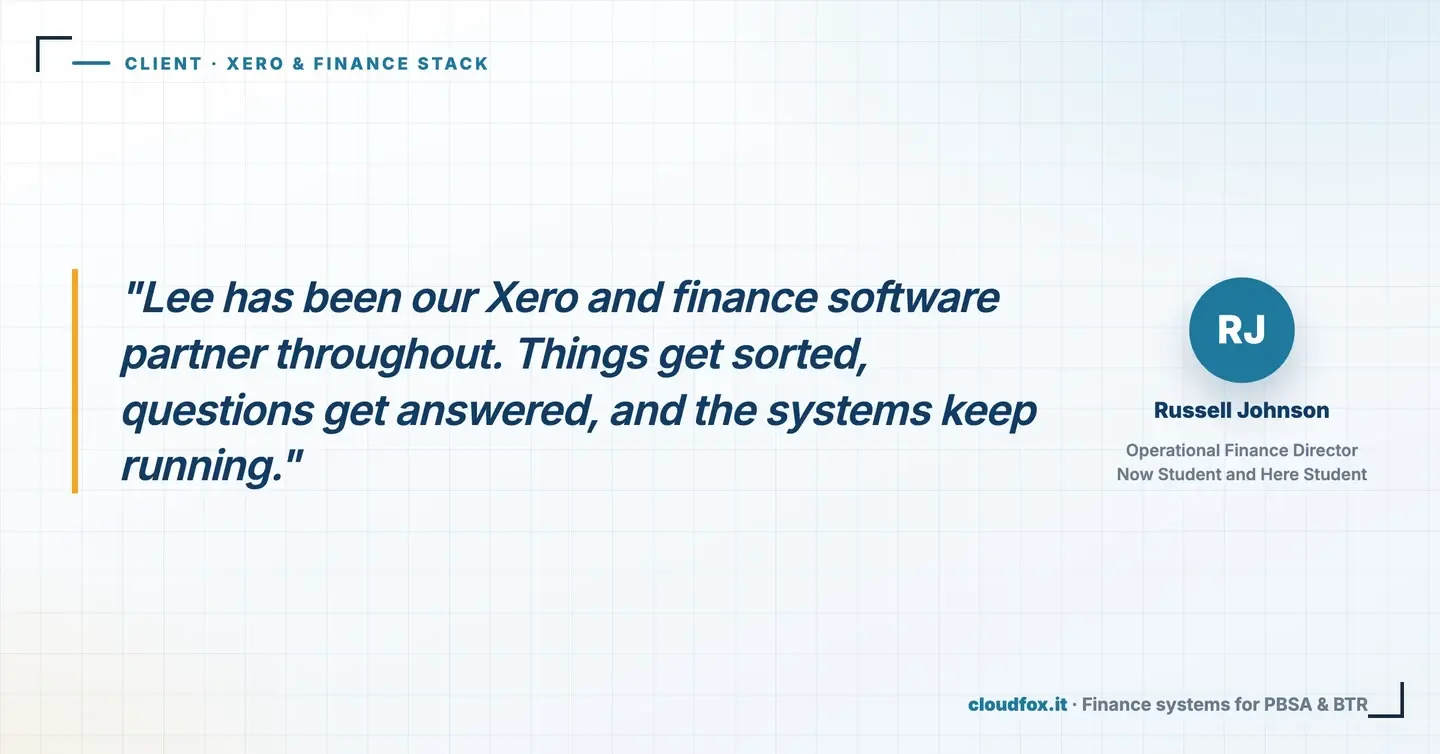
That's the part clients tend to notice over the years rather than at setup. As Russell Johnson, Operational Finance Director at Now Student and Here Student, puts it: "Lee has been our Xero and finance software partner throughout. Things get sorted, questions get answered, and the systems keep running."
Which Syft you get isn't one answer. It's one answer per entity, and for most property groups it's an answer nobody has checked. Ultimate won't deepen your forecast. No Xero tier will consolidate your group. And the entity carrying your real planning work is more likely to be on the teaser than the tool. None of that is hard to put right. It's just never anybody's job on a Tuesday.
If you can't say which plan each of your entities is on, that's the place to start, and it's a short exercise: a pass across the group's Xero subscriptions to establish what's where, and which entities genuinely justify Comprehensive. Message me and I'll walk you through how we map it.